Case study
Training type
Continuing Education Microlearning: CE and CME Examples
Continuing education microlearning delivers CE or CME content as short, focused modules that busy professionals can complete between shifts and still earn credit for. The examples below come from real association and medical society programs, including HPNA's nursing education and EmPRO's CME-accredited course completed by more than 1,600 physicians.
Continuing education microlearning examples
10 videos. Click any card to play it here.
Case study
The HPNA Success Story: 1573% Utilization
Case study
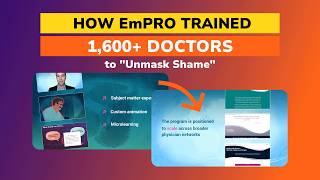
How EmPRO Trained 1,600+ Doctors to "Unmask Shame"
Example
Medical Training Example with Engaging Articulate Rise 360 Incorporating Level 2 Interactivity
Example
5 Microlearning Examples That Increase Engagement and Completion Rates in Association Learning
Case study
USA Swimming: Scalable Certification and Club Training with Microlearning Videos | Case Study
Case study
Building OCP Academy: Reaching Thousands in Just 6 Months
Example
Maple LMS Review | How Associations Scale CE Credits & Non-Dues Revenue
Example
Best Association LMS Review: An Unfiltered Review of Oasis LMS
Interview
Monetizing Association Learning | Erick Prospero ft. Matt Peterson
What is continuing education microlearning?
Continuing education microlearning is CE or CME content broken into short modules, each built around one objective, that professionals complete on their own schedule to maintain a license or certification. It replaces long recorded lectures with focused videos, scenarios, and quick assessments, while still meeting the documentation that accrediting bodies require for credit.
Nurses, physicians, and other credentialed professionals rarely have an uninterrupted hour. They learn between shifts, on a phone, or in a few minutes at a time. Long recorded webinars often get started and abandoned.
Short modules fit that reality. Each one has a clear objective, a realistic scenario, and a check for understanding. Spacing modules over weeks also supports retention better than a single long session, which is well established in learning research.
For associations and medical societies, the format has a second advantage: it is easier to package, price, and update, which matters when education is a revenue line.
What should you notice in these CE microlearning examples?
The continuing education examples above share a pattern: each one starts from a workforce problem, uses scenarios drawn from real practice, and measures more than completion. HPNA tracked utilization and learner outcomes, and EmPRO measured confidence across specific competencies. Pay attention to how short, practice-based units carry credit-bearing content.
HPNA POLARIS (hospice and palliative nursing). The Hospice and Palliative Nurses Association faced a national shortage of trained hospice and palliative clinicians and static learning formats. With the Hospice and Palliative Nurses Foundation, HPNA launched POLARIS: short microlearning modules with CE credits, scenario-based learning, integrated DEIB video content, and mobile and desktop access. Over 930 learners engaged in the first four months, 96% of APRNs reported meeting learning objectives, and 86% said it enhanced their professional growth. Read the full HPNA case study.
HPNA Palliative Care Basics. A second HPNA series standardized foundational training for new clinicians. It recorded a 1,573% increase in utilization and a 90% learner satisfaction rate.
EmPRO “Unmasking Shame” (CME). EmPRO, a medical professional liability insurer, needed to help physicians recognize and manage shame in clinical settings. The CME-accredited course combined SME-led video, custom animation, and scenario-based microlearning. More than 1,600 physicians completed it, with confidence rising 15 to 18 percentage points across nine competencies tied to communication and error recovery. See the EmPRO case study.
USA Swimming (certification). USA Swimming serves more than 400,000 members, many of them volunteers. USA Swimming University centralized role-specific certification with mobile-first, ADA-compliant video and interactive scenarios. Details are in the USA Swimming case study.
What are common continuing education microlearning use cases?
Common continuing education microlearning use cases include clinical skill updates, communication and patient safety training, onboarding for new specialty clinicians, certification preparation, and member-facing courses sold for non-dues revenue. Each fits a slightly different structure, but all share short, objective-driven modules grouped into a credit-bearing series with an assessment and evaluation.
| Use case | Recommended format | Typical structure |
|---|---|---|
| Nursing specialty CE | Scenario-based video in Rise with embedded interactions | Several short modules per credit activity |
| CME on communication or patient safety | SME-led video plus custom animation and scenarios | Short modules with confidence measures by competency |
| New clinician onboarding with CE | Microlearning video series, mobile friendly | Foundational series released in sequence |
| Certification and recertification | Role-specific video and interactive scenarios | Learning path per role |
| Member-facing paid courses | Short video series with downloadable tools | Bundles or subscriptions |
| Technical or standards education | Cinematic video and interactive diagrams | Academy-style catalog |
The last row comes from OCP Academy, which turned technical specifications into an interactive learning catalog that reached thousands of learners within six months. See the OCP Academy case study.
How does continuing education create non-dues revenue?
Continuing education creates non-dues revenue when an association treats learning as a product: priced courses, credit bundles, subscriptions, and certificates sold to members and non-members. Microlearning helps because short modules can be repackaged in several ways from the same content, and updated quickly when practice standards change.
In our interview with Matt Peterson of Maple LMS, a recurring theme was that many associations already own valuable content. The opportunity is packaging and positioning it, including “dark content” that sits unused in archives. Our microlearning for associations guide covers pricing and packaging in more depth.
Technology matters too. Our reviews of Maple LMS and Oasis LMS look at automated CE credit tracking, AMS integration, and e-commerce bundling. Ninja Tropic is not an LMS vendor, so these are independent evaluations.
What should you consider for CE accreditation?
Consider accreditation requirements before you script anything. Most accrediting bodies expect measurable learning objectives, content free of commercial bias, a needs assessment, an assessment of learning, a learner evaluation, and a documented method for estimating time. Microlearning can meet all of these if the series is planned as one accredited activity.
Rules differ by profession and accreditor, so treat this as a checklist to confirm, not a rulebook:
- Objectives per module. Write one measurable objective for each short unit, then roll them up to the activity level.
- Time estimates. Credit is usually based on the time a typical learner needs. Document how you calculated it.
- Assessment and evaluation. Build both into the LMS flow so learners cannot claim credit without completing them.
- Disclosures. Faculty and planner disclosures still apply to short formats.
- Update cycle. Short modules make it easier to keep content current between accreditation reviews.
[VERIFY: confirm accreditation requirements and credit calculation rules with the relevant accrediting body for each program]
How do you get started with CE microlearning?
To get started with CE microlearning, pick one existing course with weak completion, identify the three to five practice decisions it should change, and rebuild those as short scenario-based modules grouped into a single credit-bearing activity. Pilot with a small group of members, measure completion and confidence, then use the results to price and expand.
Browse our association microlearning examples and medical society examples for more programs built this way.
Can microlearning count for CE credit?
Yes, microlearning can count for CE credit when it meets your accrediting body's requirements, which usually include defined learning objectives, an assessment, an evaluation, and a documented time estimate. Many programs bundle several short modules into one credit-bearing activity. HPNA's POLARIS program and EmPRO's CME-accredited course are both built from short, scenario-based units.
How do associations make money from continuing education?
Associations earn non-dues revenue from continuing education by selling individual courses, credit bundles, subscriptions, and certificate programs to members and non-members. Pricing often differs by membership status, which also gives non-members a reason to join. Short modules make it easier to package content in different ways, such as a monthly subscription or a topic bundle.
How long should a CE microlearning module be?
Each CE microlearning module should cover one learning objective, which usually means a few minutes of video plus a short activity or assessment. Credit is typically calculated for the full activity, so you can group modules into a series that adds up to the credit amount you want to offer. Check your accreditor's rules on how time is estimated.
Do I need a special LMS for continuing education?
You need an LMS that tracks completions, issues certificates, and records credits, ideally synced with your association management system (AMS). Several association-focused platforms handle CE tracking natively. Ninja Tropic is not an LMS vendor and builds SCORM or xAPI content that works across platforms, so your course choices do not lock you into one system.
What topics work best as continuing education microlearning?
Topics built around clinical or professional decisions work best: communication skills, patient safety, new guidelines, ethics scenarios, and practice updates. Content that needs deep reference reading may still need longer formats. A good test is whether you can describe the behavior a learner should change after each module. If you can, that topic fits microlearning well.
Work with us
Build CE your members finish
Share your current CE catalog and credit goals. We will show you how short, scenario-based modules could fit your accreditation and revenue model.
- Built by the team behind every example on this site
- Brandon Hall Group and ASAE award-winning work
- Associations, healthcare, nonprofits, and tech